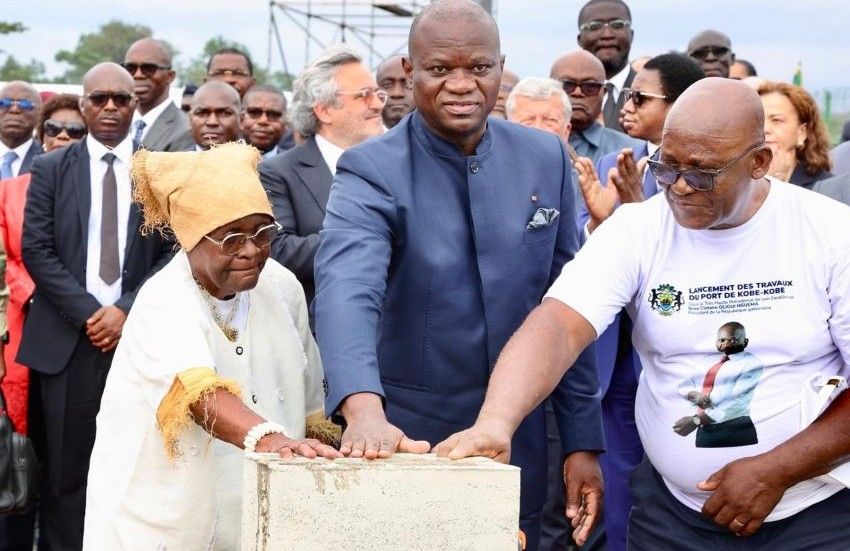
Libreville, Tuesday, June 9, 2026 – The official launch of construction on the deep-water port of Kobe-Kobe on Monday, June 8 is far more than the start of an infrastructure project. It marks Gabon’s entry into a new phase of its economic history. Behind the excavators and technical studies lies a national transformation project whose consequences could permanently redefine the country’s role in African and global trade.
In Nyonié, on the Atlantic coast of Estuaire province, President Brice Clotaire Oligui Nguema gave the green light to a program that concentrates several strategic ambitions: industrialisation, economic sovereignty, post-oil diversification, territorial development, job creation and regional influence – all now united around a single objective.
Rarely has a project mobilised so many international players and raised so many expectations among Gabonese people.
The heart of a new economic model
Viewing Kobe-Kobe as merely a port would be a mistake. The complex rests on four closely linked pillars: the Belinga iron ore deposit – one of the world’s largest untapped high-grade reserves – a new 535-kilometre railway linking production zones to the coast, a deep-water mineral port with four berths, and a 400-megawatt hydroelectric dam at Booué to power the entire system.
This integrated architecture breaks with historical patterns that long characterised African natural resource exploitation. For decades, raw materials left the continent unprocessed before being transformed elsewhere. The Kobe-Kobe project aims instead to capture more added value on national soil.
The authorities’ stated objective is clear: turn Gabon’s natural resources into a lever for industrial transformation rather than a mere export commodity. The partnership signed in April 2026 between the Gabonese state, Africa Global Logistics and Algest Investment Bank reflects this ambition to build a complete economic chain from extraction to international commercialisation.
A logistical battle for Central Africa
The real stakes, however, go beyond the mining sector alone. With a draught of 14–16 metres, Kobe-Kobe will enjoy a major natural advantage in a region where several port infrastructures are reaching their operational limits. Very large vessels will be able to dock directly, reducing logistics costs and boosting the country’s attractiveness to international investors. In a context where Central African states are seeking to strengthen their trade competitiveness, control of logistics infrastructure becomes a decisive factor.
Gabon now intends to position itself as a regional platform capable of serving not only its domestic market but also a significant portion of sub-regional trade flows. This ambition is part of the broader strategy pursued by Brice Clotaire Oligui Nguema since taking office: a country actively preparing for the post-oil era by leveraging its mineral resources, energy potential and privileged geographic location.
The presence of international partners such as China Railway, EDF-Sinohydro, Trafigura, Fortescue and Africa Global Logistics testifies to the growing credibility of this vision among global economic players.
The social challenge behind the infrastructure
Beyond investment figures, the human impact is perhaps the most anticipated dimension. Official projections mention more than 9,000 direct jobs and up to 100,000 indirect jobs by 2030. Other estimates put forward by project promoters even suggest a potential of up to 160,000 direct and indirect jobs as the industrial corridor develops.
For the populations of Nyonié, Komo-Océan and the territories crossed by future railway infrastructure, the project represents an unprecedented opportunity for economic transformation. Improved transport networks, service development, new industrial and commercial activities, and the upskilling of the national workforce could profoundly change the socio-economic landscape of several regions.
The success of Kobe-Kobe will, however, be measured by one essential challenge: turning this monumental infrastructure into a concrete engine of prosperity for Gabonese people. Behind the cranes, docks and rail convoys lies a much more fundamental question – Gabon’s ability to convert its natural wealth into sustainable development, skilled jobs and economic sovereignty.
If the stated objectives are achieved, Kobe-Kobe will not simply be a new port. It could become the symbol of an emerging Gabonese model based on industrialisation, local value creation and integration of national economic chains. Across the continent, few projects today embody this ambition so clearly: an Africa that no longer merely exports its resources but builds the infrastructure capable of transforming its future.