strengthening human rights frameworks in Sahel’s most vulnerable zones
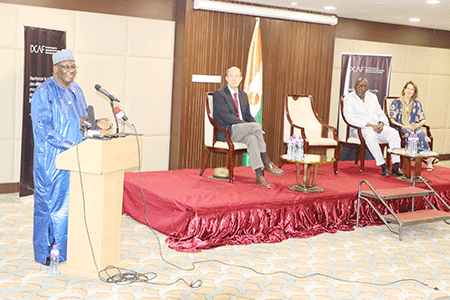
The National Human Rights Commission (CNDH) of Niger recently hosted a pivotal regional conference in Niamey, bringing together key stakeholders to address the escalating human rights challenges in the Sahel’s three-border zone—encompassing Burkina Faso, Mali, and Niger. The two-day event, held under the patronage of CNDH President Maty El Hadj Moussa, served as a platform to promote best practices, enhance institutional capacities, and foster collective action against rights violations.
The gathering attracted high-level participants, including the Deputy Secretary-General of the Ministry of Justice, the Africa Director of the Geneva Centre for Security Sector Governance (DCAF), the German Ambassador to Niger, and representatives from civil society and international partners. The agenda centered on strengthening governance, reinforcing legal frameworks, and equipping institutions with the tools needed to prevent and address human rights abuses in conflict-affected areas.
confronting dual threats to human dignity
In his keynote address, Maty El Hadj Moussa highlighted the dual nature of the crisis plaguing the region. While armed groups continue to perpetrate atrocities against civilian populations, security forces tasked with countering insurgencies have also been implicated in rights violations. “This asymmetric warfare has plunged communities into a cycle of terror, where suspicion alone can lead to irreversible violence,” he warned. “The situation demands urgent, coordinated responses from all defenders of human rights to restore peace, security, and stability.”
The conference underscored the urgency of this issue, given the region’s worsening humanitarian landscape. Political instability, social upheaval, climate-induced displacement, and transnational crime have exacerbated the erosion of fundamental freedoms, further destabilizing the region’s social fabric.
building resilience through collaboration
Moussa Sahirou Tchida, Deputy Secretary-General of the Ministry of Justice, emphasized the need for unified action among Sahelian nations. “Tackling these challenges requires a synergy of efforts, with robust support from partners like the European Union—whose backing for this conference exemplifies their commitment to our shared goals,” he stated. He reaffirmed the government’s readiness to implement strategies that enhance security and uphold human rights in the three-border zone.
Echoing this sentiment, Anne Benette, DCAF’s Africa Director, stressed that the conference was a critical step toward addressing the region’s multifaceted crises. “The Sahel’s interconnected challenges—from extremist violence to environmental degradation—demand innovative solutions born from collective learning,” she noted. “This event provides a vital space to share experiences, identify gaps, and align our responses to protect rights and restore the rule of law.”
a call for sustained international support
Herman Nicolai, Germany’s Ambassador to Niger, painted a stark picture of the Sahel’s security landscape. “The Sahel is experiencing a surge in violence unlike any other region in Africa,” he observed. “Extremist groups and transnational criminal networks have, for over a decade, unleashed untold suffering—claiming thousands of lives and displacing countless others.” He called for sustained international cooperation to curb these threats and safeguard civilian populations.
The conference concluded with a renewed commitment to collaborative efforts, emphasizing the role of regional institutions, civil society, and global partners in building resilient human rights frameworks. As the Sahel grapples with unprecedented challenges, such initiatives are essential to fostering stability, justice, and dignity for all.
Comments are closed, but trackbacks and pingbacks are open.