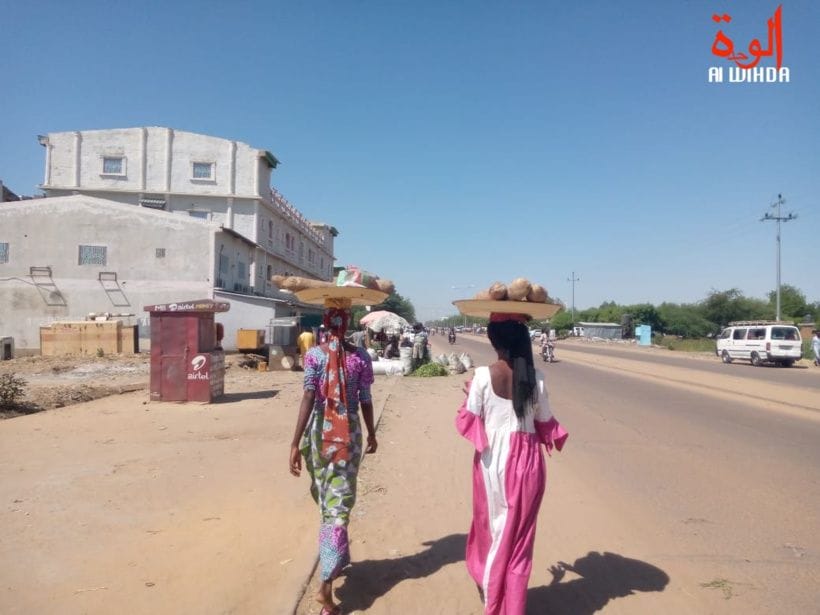
Tchad: street vendors and the hidden cost for children
In the bustling streets of Chad’s urban centers, a quiet revolution is unfolding. Women—often carrying baskets brimming with fresh fruit, sizzling snacks, or vibrant fabrics—weave through crowds under the relentless sun. Their voices rise above the hum of traffic, their footsteps quick as they navigate between motorbikes and pedestrians. From the capital, N’Djamena, to Moundou and Abéché, these women are staking their claim on the pavement, transforming the urban landscape one sale at a time.
The rise of women-led street vending in Chad
For generations, many women in Chad were confined to domestic roles within family compounds. Today, a growing number are stepping into the public sphere, embracing street vending as a pathway to financial independence. Aïcha, a vendor in her thirties, balances a tray of roasted peanuts on her head while her youngest child clings to her back. “It’s exhausting,” she admits, “but now, I make my own choices.” Nearby, Fanta tends to a small charcoal brazier, frying flatbreads as her five-year-old son plays in the dust, barefoot and unsupervised. These women are not just selling goods—they are reclaiming agency, one transaction at a time.
The transformation is visible in every major city. Markets that once operated under rigid hierarchies now buzz with the energy of self-made entrepreneurs. Women negotiate prices, manage supply chains, and navigate the challenges of urban commerce. Yet, this newfound independence comes with a heavy toll.
The silent struggle of children left behind
Amid the clamor of the markets, a darker reality persists. Children, often too young to attend school, are swept into the rhythm of their mothers’ work. Some carry heavy buckets of water, their small frames straining under the weight. Others sit for hours in the smoke of cooking fires, their lungs filling with soot. In Abéché, a local resident recalls seeing a seven-year-old boy pleading for spare change while his mother bartered for millet. “School?” he shrugs. “That was long ago.”
The trade-off is stark: as women carve out economic freedom, their children are left to fend for themselves in environments ill-suited for their age. The streets, once a place of play and learning, become a classroom of survival. Without access to education or safe spaces, many of these children face a future of limited opportunities. The irony is palpable—mothers fight for a better life, only to see their children inherit the burdens they sought to escape.
What lies ahead for Chad’s youngest vendors?
The streets of Chad tell a story of resilience and sacrifice. Women like Aïcha and Fanta embody the spirit of entrepreneurship, but their journeys are shadowed by the unmet needs of their children. Without intervention, the cycle of poverty and limited education will continue to shape the lives of these young vendors. The question remains: can Chad’s urban markets evolve into spaces that uplift entire families, or will the dreams of its most vulnerable children remain buried beneath the weight of necessity?
Comments are closed, but trackbacks and pingbacks are open.