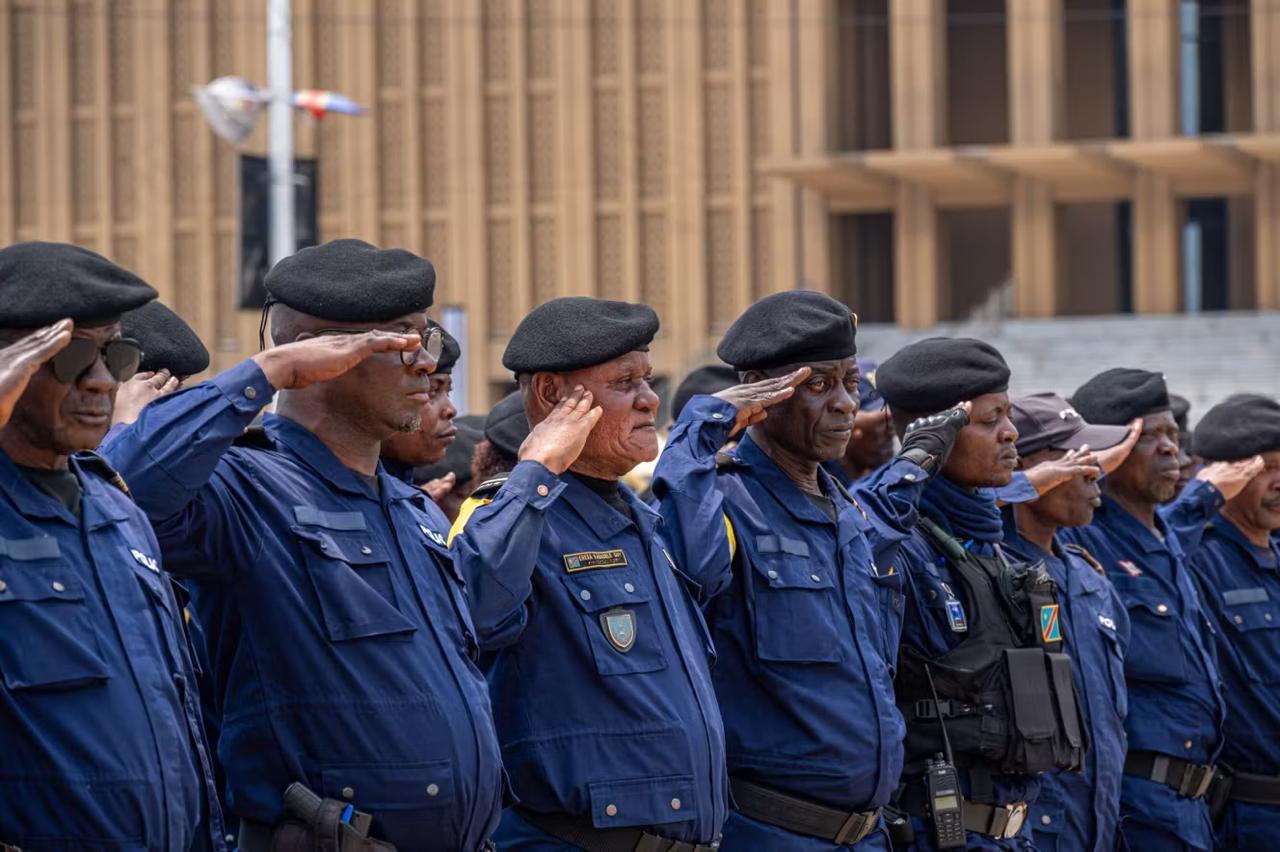
Congo braces for sweeping police reform after audit uncovers 63,817 phantom officers
An unprecedented audit of the Congolese National Police has revealed a staggering discrepancy: 63,817 officers—nearly two out of every five on official records—are either fictitious or inactive. The findings, presented to government officials, cast a harsh light on the Democratic Republic of Congo’s bloated and inefficient security apparatus.
The audit, covering a total of 157,886 registered officers, highlights a critical shortage of active personnel. With so many phantom agents draining resources, the police-to-citizen ratio has plummeted to unsustainable levels, leaving communities across Kinshasa and beyond dangerously underserved.
 Congolese police officers during a parade in Kinshasa on February 24, 2025. © HARDY BOPE / AFP
Biometric verification to purge fake officers and restore trust
In response, authorities have launched a nationwide crackdown involving physical verification and the issuance of secure biometric ID cards. The initiative, set to begin in Kinshasa, will gradually expand to all 25 provinces. The goal is to eliminate duplicate registrations, root out corruption, and streamline payroll, recruitment, and promotion processes.
This overhaul is part of a broader $2.55 billion modernization program running through 2030, which includes plans to recruit and train 90,000 new officers. The reforms aim to rebuild public trust in the police while addressing the alarming rise in violent crime, including armed robberies, kidnappings, and assaults in the capital.
Financial and security fallout from phantom payrolls
The audit estimates that fictitious officers have cost the treasury between $99.8 million and $233 million annually in wasted salaries and allowances. Beyond financial losses, the presence of ghost officers has eroded operational capacity, leaving law enforcement unable to meet the country’s growing security demands.
President Félix Tshisekedi has intensified calls for tougher action against criminal networks while pushing forward with reforms to enhance the effectiveness of security forces. The crackdown comes amid growing public frustration over rising insecurity and demands for a more responsive and accountable police service.
The government’s next steps include deploying mobile biometric verification units to remote regions, ensuring no officer escapes scrutiny. As the process unfolds, the hope is to restore both public confidence and the operational integrity of the Congolese National Police.
Comments are closed, but trackbacks and pingbacks are open.