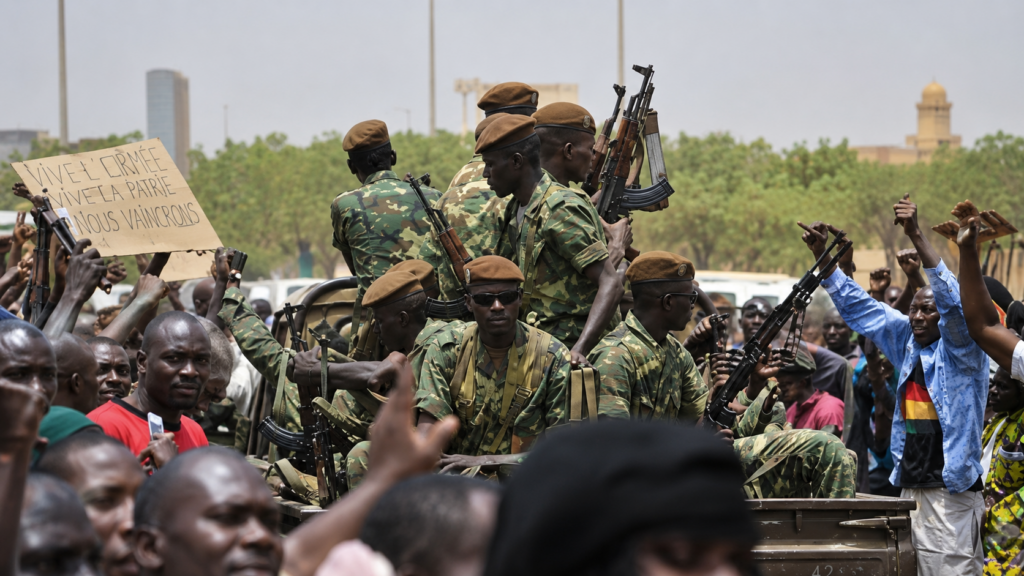
The events of early 2026 signal more than a tactical defeat; they represent the fundamental breakdown of the political vision championed by the Malian military since 2021. Without the intervention of Russian Africa Corps mercenaries, the regime in Bamako would likely have collapsed long ago.
By centering its legitimacy on the concept of “security sovereignty,” the military leadership constructed a narrative based on a single promise: that by removing foreign influence, the state would finally be able to reclaim its territory. Three years later, reality has shattered this claim, leaving the government’s rhetoric in tatters.
A massive, synchronized offensive launched by the JNIM in late April, in coordination with Tuareg separatists from the Front de libération de l’Azawad, struck key locations including Kidal, Gao, and Mopti, even reaching the outskirts of Bamako. This represents a massive strategic failure for the current administration.
The death of Defense Minister Sadio Camara, a central figure in the military structure, is more than a symbolic blow. It exposes the extreme fragility of a security apparatus that the junta had claimed was both modernized and strengthened. Rather than containing the threat, the military power now appears overwhelmed by an organization capable of striking the very heart of the state. While the security situation is disastrous, the economic landscape is arguably even worse.
More concerning is how this sequence confirms a structural evolution of the JNIM. The group is no longer a peripheral force limited to rural bushlands; it has become an actor capable of orchestrating complex, coordinated, and politically targeted operations. This surge in power has occurred despite—and perhaps partially because of—the junta’s strategic pivot, which involved breaking ties with Western partners in favor of a heavy reliance on Russian security actors whose actual effectiveness remains highly questionable.
Official statements insisting on the resilience of the state and the prowess of the FAMAs now function more as political propaganda than a realistic assessment of the situation. It is a narrative that few in Mali still find credible. While state institutions technically remain, the primary concern is no longer just their survival, but their total loss of authority. By failing to provide lasting security and allowing attacks to creep toward major urban centers, the military regime is dismantling the very foundation of its own right to rule.
The crisis is further deepened by the fact that local dynamics are increasingly slipping away from the control of Bamako. The tactical cooperation seen between the JNIM and certain Tuareg armed groups highlights the failure of a purely military response to the conflict. By treating the Malian crisis solely as a security issue, the junta has ignored the vital political, social, and territorial dimensions. This oversight has helped forge a diverse front united by a shared rejection of the central government.
The junta’s security gamble appears not only weakened but fundamentally flawed. Increasing military hardware and hiring foreign contractors has failed to change the war’s trajectory. On the contrary, insurgent groups have shown a superior ability to adapt, taking advantage of governance failures, communal friction, and the persistent lack of public services.
On a regional level, the impasse in Mali also sheds light on the shortcomings of the Alliance of Sahel States. Though marketed as a sovereign answer to regional instability, it is struggling to show any real progress against agile, transnational armed groups. Instead of a solution, it risks becoming another framework for collective paralysis.
Ultimately, the current situation reveals a deep contradiction: the junta built its reputation on restoring safety, yet it is on this exact front that it is failing most visibly. The JNIM is no longer just a symptom of a weak state; it has become the most brutal evidence of its decline. By sticking to a strictly military interpretation of the war, the leadership in Bamako seems unable to address the deeply political nature of the crisis it promised to fix.
Comments are closed, but trackbacks and pingbacks are open.