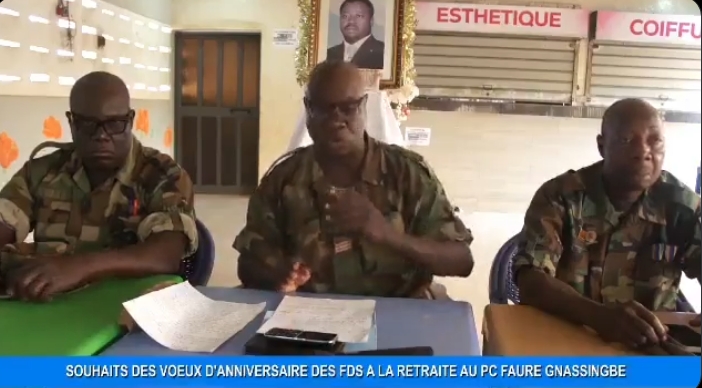
In an increasingly contentious political climate, recent pronouncements attributed to groups identified as loyalist militias or paramilitary elements have provoked significant apprehension among Togo’s civil society and opposition. Recordings and online interventions feature individuals declaring an unwavering commitment to “defend the power of the Gnassingbé family until death,” even in the face of widespread popular dissent.
These assertive declarations, which appear to disregard the republican duty of political neutrality, reignite critical discussions regarding the security of the political sphere and the precise nature of the forces supporting the incumbent administration.
A pledge of absolute fidelity beyond republican norms
The discourse emanating from these factions is characterized by a stark departure from the principle of state impartiality. By explicitly linking their security mandate to the political survival of a presidential dynasty, rather than to the nation’s Constitution or its established institutions, these actors position themselves as a form of “praetorian guard.”
« If the people no longer want them, we will fight to the end. »
This particular phrase, frequently echoed in the statements of these groupings, is widely interpreted by observers as an overt attempt at intimidation, aimed at stifling the aspirations for change held by a segment of the population. It also raises profound questions about the potential existence of parallel armed structures or radicalized elements operating within an informal security apparatus.
Reactions from civil society and the opposition
For human rights organizations and opposition leaders, these remarks are not to be dismissed lightly. They evoke memories of darker periods in Togo’s political history, which were often marred by episodes of political violence.
- Threat to Democratic Process: The opposition asserts that these pronouncements are designed to cultivate an atmosphere of fear, thereby discouraging any peaceful popular mobilization.
- Call for State Accountability: Numerous collective bodies are urging public authorities and the official military command to clarify their stance regarding these elements and to unequivocally condemn such verbal excesses.
The imperative of defense force neutrality
In the realm of Africa politics English journalism, analyzing such statements necessitates a clear distinction between official state structures and the zealous initiatives of pressure groups or private militias. In Togo, the regular army has historically been a pivotal pillar of political power. However, the public emergence of groups claiming an “ultimate shield” role outside official channels could signal a troubling inclination towards the privatization of legitimate state violence.
To date, official Togolese authorities have refrained from offering direct commentary on these specific declarations, maintaining a public posture focused on institutional stability and national security in the face of regional threats.
Outlook: As the nation navigates a complex post-constitutional landscape, the management of these ultra-loyalist discourses will serve as a crucial indicator of the Lomé government’s willingness to foster peaceful political dialogue or to lean towards a strategy of confrontation. This dynamic will be a key aspect of African news today concerning Togo.
Comments are closed, but trackbacks and pingbacks are open.